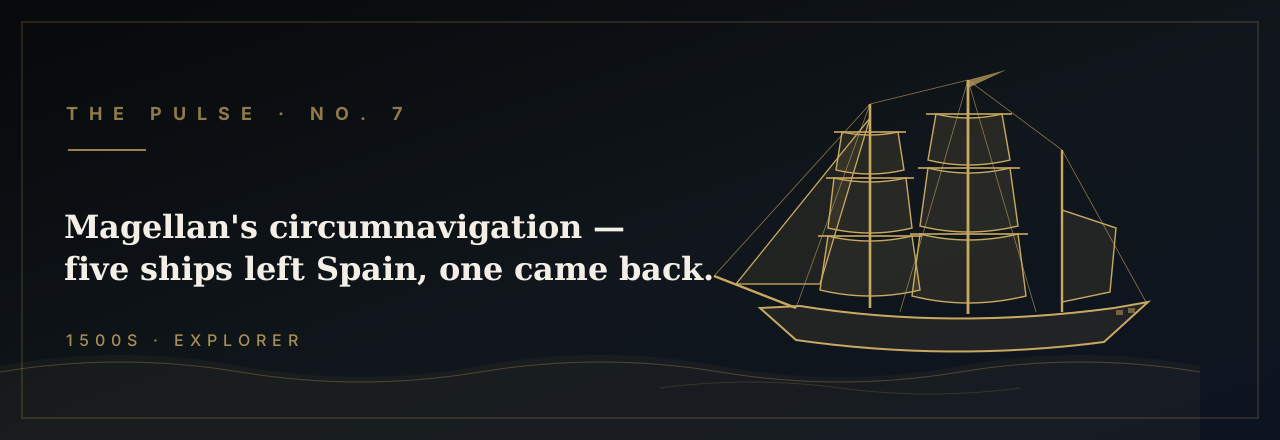
Magellan's circumnavigation — five ships left Spain, one came back.
Ferdinand Magellan didn't finish it. Sebastian del Cano brought the last ship home. The world had been proven round the hard way.
On the morning of September 20, 1519, five ships slipped out of the Spanish port of Sanlúcar de Barrameda under the command of a Portuguese mariner sailing for the Spanish crown. Ferdinand Magellan had convinced King Charles I that a westward route to the Spice Islands of Southeast Asia was not only possible but profitable. His fleet — the Trinidad, San Antonio, Concepción, Victoria, and Santiago — carried roughly 270 men, provisions for two years, and an ambition so staggering it had never been attempted. What followed was not a triumph of one man but of stubborn human survival across three years, two oceans, and every variety of catastrophe the world could produce.
The voyage nearly collapsed before it left European waters. Magellan's Spanish captains, resentful of their Portuguese commander and suspicious of his sealed orders, mutinied at Port Saint Julian on the Patagonian coast in April 1520, just seven months into the voyage. Captains Gaspar de Quesada and Juan de Cartagena led the uprising; Magellan crushed it with swift violence, executing Quesada and marooning Cartagena on the desolate shore. It was a necessary brutality — commanders who showed mercy to mutineers rarely lived long enough to finish their voyages. Then, in May, the Santiago was wrecked in a storm while scouting ahead. The fleet was down to four ships before it had even found the passage south.
The Strait of Magellan — 350 miles of wind-scoured channels threading through the southern tip of South America — took 38 days to navigate. The passage was tortuous: blind channels, tidal rips, williwaw squalls that dropped without warning from the Andean peaks above. Here the San Antonio, the largest ship and the one carrying most of the fleet's food stores, slipped away in the night and defected back to Spain, her captain claiming later that Magellan had gone mad. Three ships emerged into the open water to the west on November 28, 1520. Magellan wept when he saw the calm blue expanse ahead. He called it Mar Pacífico — the peaceful sea. He had no idea it was the largest ocean on earth.
The Pacific crossing took ninety-eight days. For almost a third of a year, the three ships saw nothing but water. The provisions were exhausted within weeks; the men ate rats, sawdust, leather stripped from the yardarms, and a paste made from ship's biscuit so infested with weevils it glowed in the dark. Scurvy tore through the crew — teeth loosened, gums blackened, old wounds split open. Nineteen men died before they raised land at the Marianas in March 1521. When they finally anchored and the men lurched ashore, they fell on fresh fruit like animals. The Pacific had been crossed, but the cost was already becoming clear.
Magellan reached the Philippine archipelago in April 1521 and made the decision that killed him. Drawn into a local political dispute on the island of Mactan, he led a night assault on a chief named Lapulapu on April 27 with only sixty men wading through shallow water against a force of more than a thousand. His armor stopped the arrows; a spear found a gap at his leg. The men fell back to the boats; Magellan stayed to cover their retreat and was dragged under by the crowd. He was forty years old. The fleet's chronicler, Antonio Pigafetta, who survived to write the only eyewitness account of the entire voyage, recorded that Magellan died "our mirror, our light, our comforter, and our true guide." What the remaining men mostly felt was terror.
The losses compounded. With too few sailors to man three ships, the surviving officers burned the Concepción at Bohol in May 1521. Two ships — the Trinidad and the Victoria — pressed on to the Moluccas, the Spice Islands, and loaded their holds with cloves. Then the Trinidad's hull opened; she was too waterlogged to make the return crossing and attempted to sail east back across the Pacific, a desperate gambit that failed entirely. She was captured by the Portuguese, and most of her crew died in captivity. Only the Victoria remained. Her new commander was a Basque sailor named Juan Sebastián Elcano, or del Cano — a man who had participated in the original mutiny at Port Saint Julian and been pardoned when Magellan ran short of officers. He now had to bring the last ship home.
Elcano sailed the Victoria west across the Indian Ocean, skirting Portuguese-controlled waters by staying deep in the southern latitudes, and rounded the Cape of Good Hope in May 1522. He made no port calls — the Portuguese would have seized the ship and its cargo instantly. The men were dying again of scurvy and starvation, reduced to eating their remaining rats. On September 6, 1522, three years and thirteen days after five ships had sailed out of Sanlúcar, a single battered vessel with patched sails and a crew of eighteen men limped back into the same harbor. Of the 270 who had departed, fewer than one in fifteen returned. The Victoria's hold contained 26 tons of cloves — enough to pay for the entire expedition and turn a profit. The world had been proven round, its circumference measured by the bodies of the men who had sailed it.
The voyage's legacy was not immediately obvious to those who lived through it. Elcano received a coat of arms from the Spanish crown bearing a globe and the motto Primus circumdedisti me — "You first circumnavigated me." Pigafetta's account, published in fragments over the following decades, became the foundation for all subsequent understanding of the Pacific. What Magellan and Elcano had established, at ruinous cost, was that the earth's oceans were one continuous body of water — that a ship could, in theory, go anywhere. That idea would animate five centuries of deepwater sailing, eventually drawing explorers, whalers, and the United States Navy into the eastern Pacific, into the waters off San Diego Bay, where the harbor that now shelters tall ships and sailing charters was charted by men who carried, in the back of their minds, the knowledge that Elcano's eighteen survivors had brought home: the ocean is crossable, the world is finite, and the sea will decide who gets to prove it.
Two designs for Pulse No. 7.
Bella + Canvas 3001 unisex tee. Printed on demand and shipped from the U.S. $34.99 + tax + shipping.
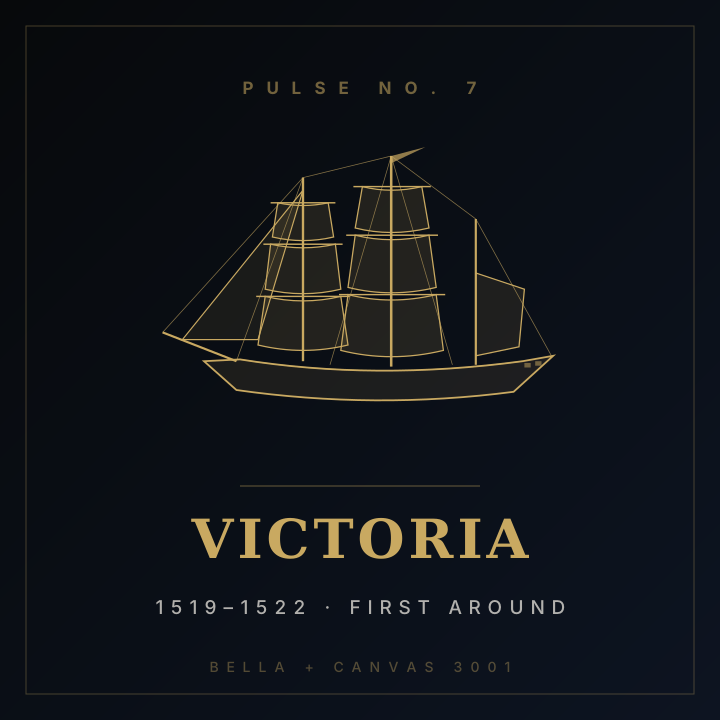
Victoria Tee
VICTORIA · 1519–1522 · FIRST AROUND
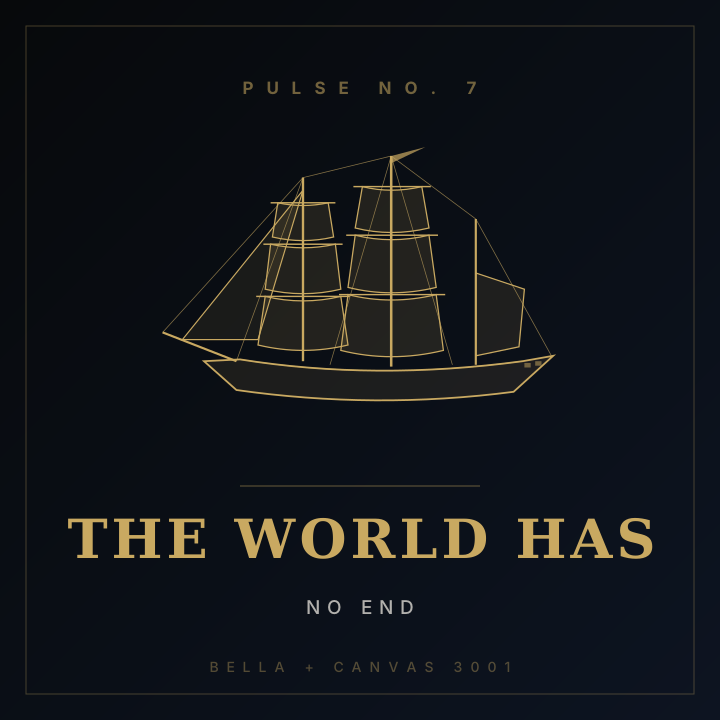
The World Has No End
Del Cano's motto, granted by the King of Spain for finishing what Magellan started.