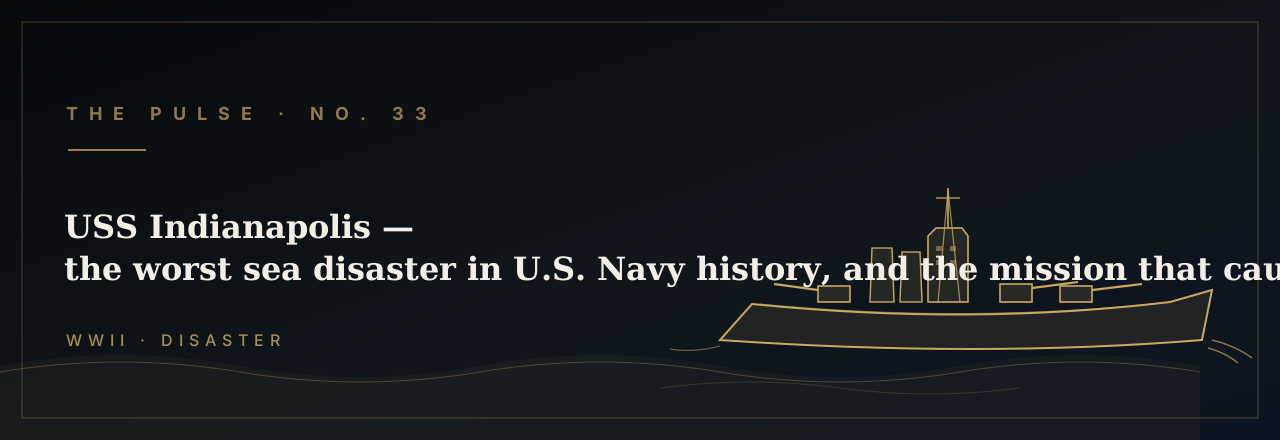
USS Indianapolis — the worst sea disaster in U.S. Navy history, and the mission that caused it.
She delivered the uranium for the Hiroshima bomb, then sank. Four days in shark-infested water. 316 survivors from 1,195.
On the morning of July 16, 1945, the heavy cruiser USS Indianapolis slipped out of Hunter's Point Naval Shipyard in San Francisco carrying a cargo so secret that her own crew did not know what rode in the specially welded canister bolted to the deck of her flag cabin and the lead-lined crate stowed in the hold below. Captain Charles Butler McVay III had been told only that the material must reach Tinian Island in the Marianas in ten days or less — and that its loss would cost the war. Indianapolis made the crossing in record time: nine days, fourteen hours, arriving on July 26. Within hours, Army Air Forces ground crews had unloaded the components of Little Boy — the enriched uranium-235 gun assembly and its target insert — and transferred them to the airfield where Enola Gay sat waiting. The most consequential sea voyage of the twentieth century was complete. What followed was the worst maritime disaster in United States Navy history.
The Indianapolis was no ordinary cruiser. A Portland-class heavy cruiser commissioned in 1932, she had served as the flagship of the Fifth Fleet under Admiral Raymond Spruance and had taken a kamikaze hit off Okinawa just months before, killing nine men and blasting a hole through her hull. She had been repaired at Mare Island in haste and sent back to the Pacific, not fully combat-ready but deemed fit for the secret Tinian run. The mission derived from the highest levels of the Manhattan Project; Secretary of War Henry Stimson himself approved the shipment. When the cargo was delivered and Indianapolis was assigned to transit from Tinian to Leyte Gulf in the Philippines for gunnery training, she departed on July 28 under routine sailing orders — no destroyer escort, no anti-submarine zigzag directive, no specific instructions to report her arrival at Leyte. She was, in the bureaucratic machinery of a Navy prosecuting a global war, simply one cruiser moving between ports.
Shortly after midnight on July 30, 1945, Japanese submarine I-58, commanded by Commander Mochitsura Hashimoto, detected a large contact on the surface and fired a spread of six Type 95 oxygen-propelled torpedoes from a range of roughly 1,500 yards. Two struck home in rapid succession — the first detonating beneath the bow, vaporizing the forward magazine and igniting aviation fuel; the second gutting the midship section amidships near the fire room. Within twelve minutes, Indianapolis had rolled onto her starboard side and slid beneath the Philippine Sea. Of the 1,195 men aboard, an estimated 800 to 900 made it into the water. They had almost no life rafts — most of the raft storage areas were destroyed in the explosions or inaccessible in the dark — and the ship had gone down so quickly that a general distress signal, though transmitted, was never confirmed received by any shore station that acted on it. Three stations actually received the signal; all three, for bureaucratic and operational reasons, ignored it.
What followed in the warm, black water of the Philippine Sea constitutes one of the most harrowing documented survival ordeals in naval history. The men were scattered across several miles of open ocean in groups ranging from hundreds to a handful. Many had swallowed fuel oil, burning their throats and lungs. Lifejackets, designed for a maximum of forty-eight hours of buoyancy, began to waterlog and sink by the second day. Dehydration drove men to drink seawater, inducing the hallucinations and violent psychosis that caused many to drown or to be drowned by delirious shipmates. And then there were the sharks. Oceanic whitetip sharks — among the most aggressive of pelagic species, known to feed on wreck survivors throughout the Pacific war — began circling within hours. They attacked singly and in groups, targeting men on the periphery of clusters, men who had lost consciousness, men who could no longer fight. Survivors later described being unable to sleep, taking turns holding one another upright, watching comrades pulled below without a sound. Over four days and five nights, roughly 580 men died in the water from drowning, exposure, dehydration, psychosis, and shark attack.
The Navy did not know Indianapolis was missing. This was not sabotage or enemy action — it was a catastrophic failure of institutional procedure. The port director at Leyte, operating under a standing order that non-arrival of combatant vessels was not to be reported, made no inquiry when the cruiser failed to appear. The routing authority at Guam, which had cleared her departure, assumed she had arrived at Leyte. No one held the thread. The men floated in the Philippine Sea for eighty-four hours before they were found — and they were found entirely by accident. On the afternoon of August 2, Navy Lieutenant Wilbur Gwinn, flying a PV-1 Ventura on a routine anti-submarine patrol, noticed an oil slick below and descended to investigate. What he saw in the water stopped him cold. He radioed his sighting immediately, and the rescue that followed — conducted by seaplanes, destroyers, and every available vessel — pulled 316 men from the sea. They were the last survivors of a crew of 1,195.
The Navy's response to the disaster was, in the view of many historians, a second catastrophe. Captain McVay was court-martialed in December 1945 — the only American commanding officer tried for the loss of his ship in the entire Second World War — on two charges, one of which was hazarding his vessel by failing to zigzag. In an almost surreal turn, Commander Mochitsura Hashimoto, the Japanese officer who had sunk the ship, was brought to Washington to testify at the court martial, where he stated unequivocally that zigzagging would not have changed his attack's outcome. McVay was nonetheless convicted. For the rest of his life he received hate mail from the families of the dead — some of it written by children assigned to compose letters as school exercises. He retired in 1949 as a rear admiral, moved to Litchfield, Connecticut, and on November 6, 1968, was found dead by his gardener, a toy sailor in his hand. In October 2000, Congress passed a resolution and President Clinton signed legislation exonerating McVay and directing that his record reflect his cleared name — fifty-five years too late, and twenty-three years after his death.
The story of Indianapolis reaches directly into San Diego's naval identity. Naval Base San Diego, the largest surface warfare base on the West Coast and the homeport of the Pacific Fleet's destroyers and cruisers, stands as the institutional heir to the Pacific surface force that fought the war Indianapolis served. The procedural failures that left her men unreported and unrescued led directly to reforms in Navy port reporting, ship tracking, and overdue vessel notification protocols — reforms that govern every surface warfare vessel homeported in San Diego today. The cruiser also has a more intimate local connection: several of her survivors settled in Southern California after the war, and the USS Indianapolis Survivors Organization, active until the last surviving member died in 2023, regularly attended commemorations in the region. The ship's story is woven into the fabric of what it means to serve in the Pacific, and San Diego's waterfront — where destroyers and cruisers depart on deployment every month — carries that weight whether those aboard know it or not.
What the sinking of Indianapolis ultimately illuminates is the paradox at the heart of the Pacific War's final chapter. The cruiser delivered the weapon that ended the war, then vanished into the sea before the weapon was even dropped. The men who died in those four days perished in the last weeks of a conflict that was, by then, all but won — killed not by a strategic naval engagement or a decisive fleet action, but by a single submarine, institutional negligence, and the indifferent biology of the open ocean. The legacy of Indianapolis has never faded, partly because the math is so stark — 316 from 1,195 — and partly because the story contains every element of what the sea can do when men and institutions fail it: hubris, silence, darkness, and the long wait for a plane that almost didn't look down.
Two designs for Pulse No. 33.
Bella + Canvas 3001 unisex tee. Printed on demand and shipped from the U.S. $34.99 + tax + shipping.
Indianapolis Tee
USS INDIANAPOLIS CA-35 · JULY 30, 1945
The Mission That Couldn't Be Reported
Indianapolis's orders were classified. That's why nobody noticed she was missing.