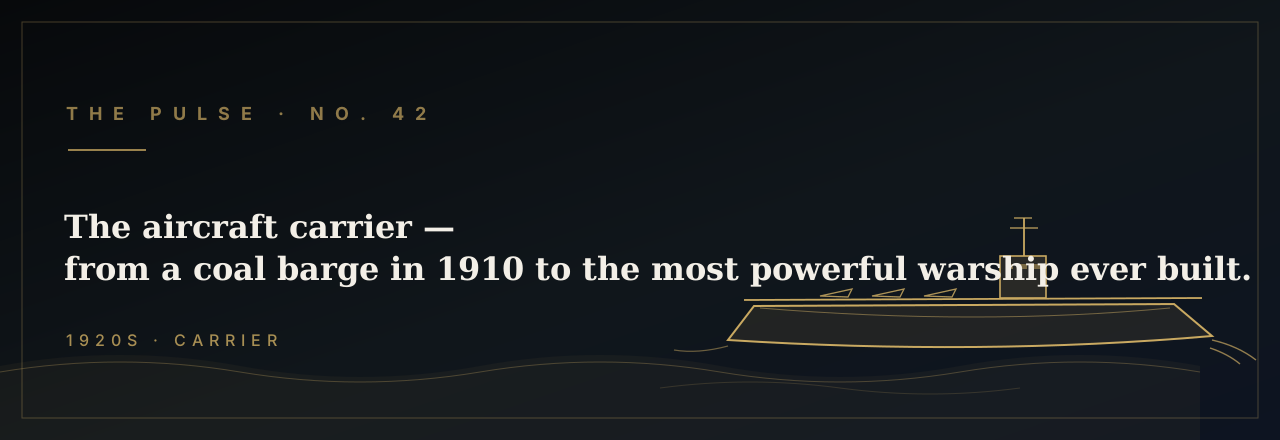
The aircraft carrier — from a coal barge in 1910 to the most powerful warship ever built.
It started with a pilot landing on a moving ship for a bet. It ended with 100,000-ton nuclear vessels that project power anywhere on earth. San Diego is where a lot of that history happened.
On the morning of January 18, 1911, a twenty-four-year-old exhibition pilot named Eugene Ely climbed into a Curtiss pusher biplane on the deck of the armored cruiser USS Pennsylvania, anchored in San Francisco Bay, and proved that heavier-than-air flight and naval warfare could share the same hull. Two months earlier he had made the first-ever takeoff from a warship, lifting off the foredeck of USS Birmingham in Hampton Roads with barely enough runway to avoid drowning in the harbor mud. That January morning he landed — a crude arresting gear of ropes weighted with sandbags caught his wheels — reversed his engine, and stopped in thirty feet. The assembled officers who had wagered $1,000 that the feat was impossible paid up. Within a generation, the idea those men dismissed as a stunt would render every one of their battleships strategically obsolete.
The British, as so often in naval innovation, moved first. HMS Argus, commissioned in September 1918, was the world's first true flush-deck aircraft carrier — an ocean liner hull converted to a flat-topped floating airfield with no superstructure to obstruct flight operations. She arrived too late for the war she was built to fight, but she validated the concept thoroughly, and the Royal Navy spent the interwar years refining what she demonstrated. Then the Washington Naval Treaty of 1922 committed an act of unintentional genius: by capping battleship and battlecruiser construction, it left the world's great navies holding incomplete capital ship hulls they could no longer legally finish as designed. The treaty permitted conversion of those hulls to carriers up to 33,000 tons, and Japan and the United States raced to exploit the loophole. The carrier age had just been handed its seed money.
America's first carrier was humbler than any converted battlecruiser. The USS Langley (CV-1), commissioned on March 20, 1922, was a converted Navy collier — a coal barge, in the contemptuous phrase of battleship admirals — that had spent a decade shuttling fuel to the fleet under the name Jupiter. Rebuilt with a 534-foot flight deck, she became the laboratory in which American naval aviators invented carrier doctrine from scratch. Her early officers, led by aviation pioneer Commander Kenneth Whiting, devised landing signals, improved arresting gear, catapult launch procedures, and the choreography of flight deck operations — the organized chaos of fueling, arming, and spotting aircraft that remains essentially unchanged a century later. Langley's slow 14-knot top speed made her tactically useless for fleet operations, but she was the mother of everything that followed. The Navy called her "Covered Wagon." Her pilots called her home.
What followed arrived in 1927, and arrived at scale. The USS Lexington (CV-2) and her sister USS Saratoga (CV-3) were converted from 888-foot Lexington-class battlecruiser hulls that the Washington Treaty had stopped dead on the ways. Each displaced 36,000 tons, carried 78 aircraft, and could make 33 knots. Their size allowed a remarkable byproduct: turbo-electric drive that generated such surplus electricity that Lexington famously supplied power to the city of Tacoma, Washington during a utility crisis in 1929, connecting her transmission lines to the city grid for a month. More strategically, their speed and deck space gave American aviators room to develop the massed deckload strike — launching every aircraft simultaneously against a single target — the decisive tactical innovation of the Pacific War. When the two ships arrived with the Pacific Fleet, their combined air wings outnumbered the total combat aircraft of most of the world's smaller navies.
The Japanese watched, matched, and in certain respects surpassed. Hōshō, commissioned in December 1922, edged both American conversions into service as the world's first purpose-built carrier. Japan then converted the battlecruiser Akagi and the battleship Kaga, creating the carrier striking force that would train the aircrew and refine the tactics of the Kidō Butai — the six-carrier fleet that opened the Pacific War by attacking Pearl Harbor on December 7, 1941. Vice Admiral Chūichi Nagumo's task force had spent two decades perfecting at sea what Ely had improvised in a single morning. The attack that Sunday destroyed the American battle line and, in doing so, handed strategic initiative to the three fleet carriers the Japanese had failed to catch in port — Enterprise, Lexington, and Saratoga — each of them absent from Pearl Harbor on missions of their own.
San Diego is where a great deal of that carrier history assembled, trained, and came home. Naval Air Station North Island, established on Coronado in 1917, became the West Coast's primary carrier homeport and the center of Pacific Fleet aviation. Saratoga called San Diego home between deployments; the fighter and torpedo squadrons that fought at Coral Sea and Midway trained in the skies above Point Loma and San Clemente Island. After the war, the pattern only deepened. Naval Base Coronado today anchors the headquarters of Naval Air Forces Pacific, and every carrier strike group deploying to the Western Pacific or the Persian Gulf stages through the same harbor where Pennsylvania's officers once scoffed at the notion of a biplane landing on a warship. The city and the carrier grew up together.
The proving ground came in the spring and summer of 1942. At the Battle of the Coral Sea in May, American and Japanese carrier forces traded blows across 200 miles of open ocean without the opposing ships ever sighting each other — the first naval engagement in history decided entirely by aircraft. One month later, at Midway, dive bombers from Enterprise, Hornet, and Yorktown caught three Japanese fleet carriers with loaded aircraft on their flight decks and reduced all three to burning hulks within six minutes. A fourth, Hiryū, followed that afternoon. The Kidō Butai that had taken two decades to build and man was broken in a morning, its most experienced carrier aviators killed with their ships. The question the battleship admirals of 1911 had never believed required answering was settled with cruel finality: the carrier was now the capital ship, and everything else — every cruiser, destroyer, submarine, and battleship — existed to protect or enable it.
The postwar decades drove that lesson to its logical, almost incomprehensible extreme. The Nimitz class, first commissioned in 1975, produced ten ships of 1,092 feet and 100,000 tons, each powered by two nuclear reactors capable of operating for twenty years without refueling, each carrying 90 aircraft and a crew of more than 5,000 — a self-contained mobile air base that can generate 120 combat sorties a day from any ocean on earth. The Gerald R. Ford class, entering service in 2017, replaced steam catapults with electromagnetic launch systems, upgraded the reactors to double the electrical output, and reduced the crew required to operate the ship. These vessels displace roughly the same tonnage as every ship present at Trafalgar combined. Eugene Ely's sandbag arresting wire has become an advanced recovery system engineered to absorb 50,000 foot-pounds of kinetic energy; his canvas biplane has become an F-35C with a combat radius of 670 miles. The wager he made on a January morning in San Francisco Bay — that a man could land on a moving ship and live — turned out to be the most consequential bet in the history of naval warfare.
Two designs for Pulse No. 42.
Bella + Canvas 3001 unisex tee. Printed on demand and shipped from the U.S. $34.99 + tax + shipping.
Carrier Tee
THE FLATTOP · 1927–PRESENT
Cat Launch
The steam-powered catapult that makes modern carrier operations possible.