USS San Diego — the luckiest ship in the Pacific War.
CL-53 was the most decorated U.S. ship of World War II. Eighteen battle stars. She was called "The Little Bitch" by her crew, affectionately. She came through the entire war without losing a man to enemy fire.
When the keel of USS San Diego was laid at Bethlehem Steel's Fore River Shipyard in Quincy, Massachusetts, in March 1940, the Navy had in mind a very specific killing machine. The Atlanta-class light cruisers were not designed for the graceful long-range gunnery duels of their heavy cruiser cousins. They were built around the 5-inch/38 caliber gun — sixteen of them in eight twin mounts, capable of hurling nearly twenty proximity-fuzed shells per minute into the sky — making each Atlanta-class hull a bristling anti-aircraft platform unlike anything then afloat. Commissioned on January 10, 1942, just thirty-four days after Pearl Harbor, San Diego entered a Pacific war that had already demonstrated exactly how badly such ships were needed. She would spend the next three and a half years proving, in battle after battle, that the admirals who designed her had gotten something exactly right.
She joined the fight immediately, slotting into the vast chess game of carrier warfare as an anti-aircraft screen for the fast carrier task forces. The work was unglamorous — no shore bombardments, no surface engagements against enemy warships — but it kept the fleet's most valuable assets alive, and its importance became brutally clear in November 1942, during the Naval Battle of Guadalcanal. Two of San Diego's sister ships — USS Atlanta (CL-51) and USS Juneau (CL-52), launched within months of her from the same design — were both sunk in the same furious night action on November 13. Atlanta was torn apart by torpedo and friendly fire; Juneau, struck by a single Japanese torpedo that detonated her forward magazine, vanished in twenty seconds, taking 687 men including all five of the Sullivan brothers. San Diego was elsewhere that night. She would be elsewhere, in the luckiest sense, for the rest of the war.
From 1943 onward, San Diego accumulated battle stars the way other ships accumulated barnacles. She covered the landings in the Gilbert Islands in November 1943, her anti-aircraft batteries swatting down Japanese bombers as Marines died on the beaches below. She screened the fast carriers through the Marshall Islands campaign in early 1944, and was among the warships that swept into the supposedly impregnable Japanese anchorage at Truk Lagoon during Operation Hailstone on February 17–18 — a two-day carrier air assault that sank more than forty Japanese ships and shattered the myth of Truk as the Gibraltar of the Pacific. Through it all, her gunners remained hungry and accurate, her damage-control parties never once called to fight a fire started by enemy action, her casualty lists blank.
The summer of 1944 brought San Diego to her most spectacular theater. As part of Task Force 58 under Vice Admiral Marc Mitscher, she steamed into the Philippine Sea for the campaign to seize the Marianas. On June 19, Japanese carrier aviation made its last great offensive gamble, launching four coordinated strike waves against the American fleet. What followed became known simply as the Great Marianas Turkey Shoot: American fighters and shipboard anti-aircraft guns destroyed more than three hundred Japanese aircraft in a single day, effectively ending Japan's carrier-based air power as an offensive force. San Diego's gunners were in the thick of it, her sixteen five-inch guns arcing tracer fire into attack waves that never broke through to the carriers behind her. It was the battle she had been designed for, fought exactly as designed, and she came through it without a scratch.
The crew had a name for their ship. They called her "The Little Bitch" — not with contempt, but with the particular affection sailors reserve for a vessel that has proven herself tough, unpredictable in the best way, and stubbornly alive. At 541 feet and 6,718 tons standard displacement, San Diego was not small by any ordinary measure, but beside the fleet's battleships and heavy cruisers she was compact, nimble, and endlessly aggressive. The nickname carried the crew's pride in a record that was becoming, by 1944, something close to supernatural. Other ships took hits. Other ships held solemn ceremonies, buried their dead at sea, painted tallies of lost friends on their bulkheads. San Diego's crew polished their guns and painted on another battle star. By war's end she had earned eighteen — the most of any American warship in the entire conflict — while never once logging a combat fatality.
She was present on September 2, 1945, in Tokyo Bay, when General Douglas MacArthur accepted Japan's formal surrender aboard USS Missouri. It was a fitting witness stand for the most decorated ship in the American fleet. San Diego had been at or near nearly every major engagement of the Pacific campaign — from the Solomons to Leyte Gulf, from Truk to the bombardment of Iwo Jima — and arrived in Tokyo Bay with her hull intact, her crew alive, and a service record that no naval historian could fully explain through skill alone. Luck had clearly played its hand. But so had competence, training, and the almost compulsive professionalism of crews who understood that their ship's survival depended on shooting first, shooting accurately, and keeping the machinery of war running under the most punishing conditions the Pacific could produce.
The ship bore the name of the city at the heart of American Pacific naval power, and that was no accident. San Diego had been the Pacific Fleet's primary home port and training ground since the early twentieth century, and the cruiser that carried the city's name became an emblem of everything the fleet stood for: durability, precision, and an almost unreasonable capacity to survive. When San Diego was decommissioned in November 1946 and eventually sold for scrapping, her departure marked the end of an era for a class of ships rendered obsolete by the missile age already gathering on the horizon. The city mourned its namesake quietly, the way sailors mourn ships — with stories told in bars near the waterfront, with old photographs passed among men who had stood her watches, slept in her berthing spaces, and trusted her with their lives.
History rewards the survivors, and USS San Diego survived everything. Eighteen battle stars, zero combat deaths, three and a half years in the most violent naval theater in human history — the arithmetic of her record still reads as improbable, a statistical outlier that doubles as a monument to what American warship design, training, and fortune could accomplish in the right combination. Today, a new USS San Diego sails from the same port, an amphibious transport dock that carries Marines toward distant shores under a name connecting the present fleet to the Pacific war's most charmed hull. The tradition endures — as does the city it represents, still the center of American Pacific naval power, still sending warships out through the same channel that CL-53 once transited, still watching the fleet come home.
Two designs for Pulse No. 48.
Bella + Canvas 3001 unisex tee. Printed on demand and shipped from the U.S. $34.99 + tax + shipping.
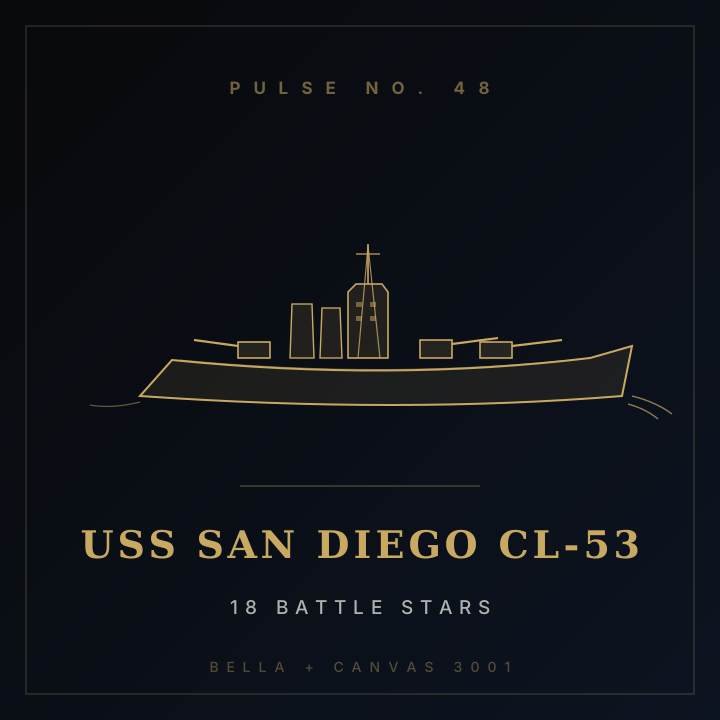
San Diego Tee
USS SAN DIEGO CL-53 · 18 BATTLE STARS
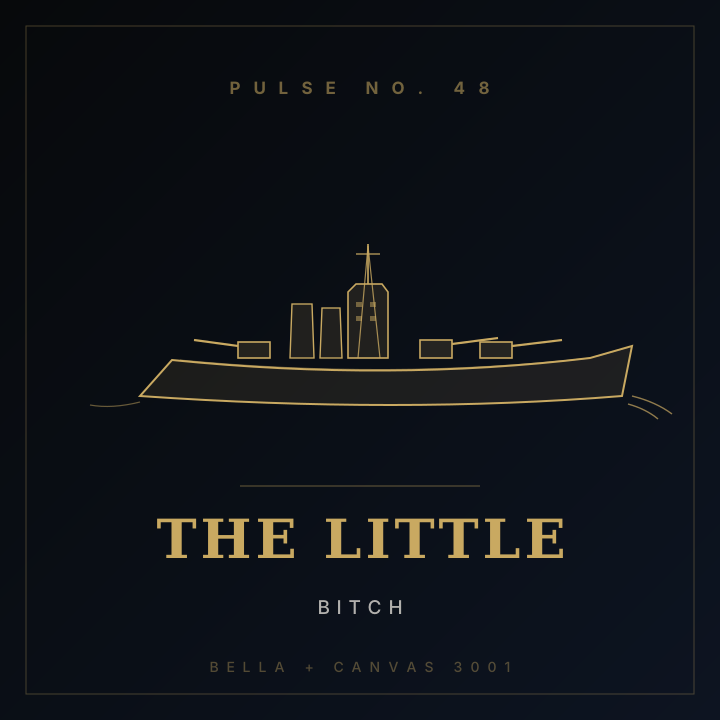
The Little Bitch
The unofficial name her crew gave the USS San Diego.