Space shuttle solid rocket recovery — the ships that chased boosters into the open Atlantic, and their San Diego connection.
NASA's Solid Rocket Booster recovery ships were purpose-built for the job. The recovered casings were shipped to Utah via San Diego.
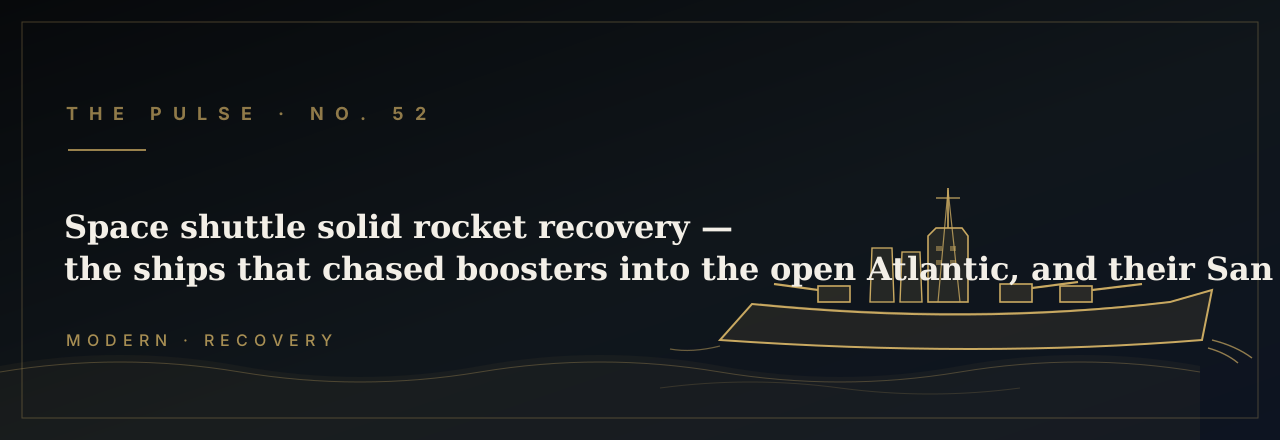
At 7:00 in the morning on April 12, 1981 — the twentieth anniversary to the day of Yuri Gagarin's first orbit — Space Shuttle Columbia lifted off Pad 39A at Kennedy Space Center and carried astronauts John Young and Robert Crippen into the Florida sky. Two minutes and four seconds into the flight, at 28 miles altitude and Mach 4.5, eight explosive bolts detonated simultaneously on each booster and the twin Solid Rocket Boosters separated from the orbiter stack, their 149-foot white casings tumbling slowly away in the thin stratospheric air. Each casing weighed 192,000 pounds empty, was twelve feet in diameter, and had just consumed 1.1 million pounds of solid propellant in roughly the time it takes to drink a cup of coffee. As they fell in a long ballistic arc toward the Atlantic Ocean 40 miles east of the Cape, a crew of twelve sailors aboard a purpose-built recovery vessel 140 miles downrange was already watching the horizon. Their vessel had been built for exactly this moment, and this was just the beginning of a maritime vocation unlike any in the history of the sea.
The twin recovery ships, MV Freedom Star and MV Liberty Star, had been constructed in 1980 by Halter Marine of New Orleans specifically for the SRB retrieval mission. Each vessel was 176 feet long with a beam of 37 feet, drawing 11 feet of water, and powered by twin diesel engines producing 3,000 shaft horsepower — enough to make 13 knots in the open Atlantic. They were owned and operated by the booster's manufacturer, Morton Thiokol Corporation of Ogden, Utah, which was contractually responsible for returning the reusable casings to flight condition. The ships were built low and wide with a stern work deck designed for the specific geometry of a floating SRB: the recovery teams would approach the casing from downwind, swim divers out to attach rigging, then pump seawater from the hollow interior through a nozzle plug until the casing rode high enough to tow. The whole evolution, from first diver in the water to the casing secured alongside for the 140-mile tow back to Port Canaveral, took roughly twelve hours in calm conditions — considerably longer in the 10- to 15-foot Atlantic swells that the recovery zone frequently delivered.
The descent sequence itself was a feat of parachute engineering. After separation, each SRB coasted unpowered to a peak altitude of about 220,000 feet before beginning its fall. At 16,000 feet, two pilot chutes deployed, pulling out a 54-foot drogue chute that slowed and stabilized the tumbling casing. At 6,000 feet, three 136-foot main canopies blossomed in a cluster that slowed the 192,000-pound casing to a water-entry speed of roughly 75 miles per hour — violent by any measure, but survivable for the thick steel cylinder. Splash-down was approximately six minutes after separation, and the guidance system had, in theory, placed the casings within a target ellipse roughly 10 by 20 miles — a target that looked large on a chart but felt quite small from the deck of a 176-foot vessel searching open ocean in the pre-dawn dark. Recovery teams used radar beacons aboard the casings to home in, though the orange-and-white parachute canopies floating on the surface were often the first visual confirmation that the casing had survived the fall intact.
Not every casing survived. On STS-4 in June 1982, both main parachute systems failed on the right-hand booster and one system failed on the left; both casings hit the water at near-terminal velocity, approximately 250 miles per hour, and sank immediately to the Atlantic floor. The $20 million casings were a total loss. The incident led to an exhaustive redesign of the parachute deployment system, including new ripcord geometry, revised canopy gores, and revised thermal shielding around the nose cap where heat-soak from ascent had been melting the drogue release mechanism. After those modifications, the Freedom Star and Liberty Star would successfully recover both casings from 131 of the remaining shuttle missions, a reliability record that the program's engineers considered the quiet engineering achievement of the entire shuttle era. The recovered hardware was visually scarred — heat tiles scorched, aluminum skin blistered, salt water in every crevice — but structurally sound, and that was what mattered.
The logistical chain that moved a recovered SRB casing from the Atlantic floor back to the Utah desert and eventually onto the next shuttle stack was more complex than most Americans realized, and it ran directly through San Diego. Morton Thiokol's manufacturing plant sat at Promontory Summit, Utah — remote, landlocked, and more than 2,000 miles from Cape Canaveral by any practical route. New booster segments were assembled in Promontory and loaded onto custom flatcars for Union Pacific's transcontinental rail network, routing south through Salt Lake City, Las Vegas, and on to the National City Marine Terminal at the Port of San Diego. There, the 149-foot segments were transferred to oceangoing barges for a 4,400-mile voyage through the Panama Canal and up the Florida coast to Port Canaveral. Recovered, refurbished casings made the return journey in reverse — offloaded at Canaveral, barged back through Panama, transferred at San Diego, and returned to Promontory by rail for inspection, propellant reloading, and eventual reassignment to a future flight. Every shuttle stack that ever flew carried hardware that had transited San Diego harbor, often more than once.
The work of the Freedom Star and Liberty Star crews was unglamorous in the extreme. The ships departed Port Canaveral roughly eighteen hours before every shuttle launch, steaming southeast to their recovery stations in open water. They would remain on station through the ascent window — sometimes waiting for days through scrubs and recycles — and then proceed to the splashdown ellipse after staging confirmation. The typical ship's company consisted of twelve to fifteen crew, several NASA technicians, and a dive team of six. In thirty years of operations, the crews experienced nearly every condition the Atlantic could produce: 20-foot swells from nor'easters tracking well offshore, tropical squalls, the flattened sea and eerie cloud light that precedes a hurricane passage, and on the better days, the deep blue of the Bahamas shelf edge under a perfect Florida sky. The crews never received a ticker-tape parade; they held no record for speed or tonnage. But they put to sea for every single shuttle mission for thirty years, and they came back with the hardware.
The program's San Diego connection did not end with the logistics chain. From the late 1980s onward, ATK Launch Systems — which absorbed Morton Thiokol through a series of corporate mergers — maintained an active relationship with the port's marine terminal operators. Several former Navy personnel from San Diego's large fleet support community found second careers in the SRB transport pipeline: rigging supervisors, barge handlers, and marine surveyors who had learned their trade on the piers of Naval Station San Diego and brought those skills to the space program's supply chain. The connection was quiet and rarely publicized, but it was real — a reminder that the industrial maritime heritage of San Diego's naval base, dating back to the Navy's first permanent Pacific fleet installation in 1919, had threaded itself into the civilian infrastructure of the space age in ways that no planner had specifically designed.
The final shuttle mission, STS-135, flew on July 8, 2011, and the Freedom Star and Liberty Star made their last Atlantic crossing to retrieve Atlantis's boosters on July 11. It was the 268th time the two ships had steamed out of Port Canaveral on a recovery mission. Both vessels were subsequently sold, their specialized recovery equipment stripped and their names changed — the Freedom Star eventually joining the commercial offshore fleet. The booster casings themselves, stacked in a storage yard at Kennedy Space Center, were never flown again. What those thirty years of operations had demonstrated, however, was a principle as old as seafaring itself: that the most consequential maritime work is often the most methodical, the most unglamorous, and the least observed. The sailors who chased spent rocket casings into the open Atlantic did not fly the ships that sailed to the moon. They did something in some ways more difficult — they showed up, in all weather, and brought the hardware home, voyage after voyage, for three unbroken decades, ferrying the machinery of human ambition through the same Pacific swells that had once carried Spanish galleons past the headlands of San Diego Bay.
Two designs for Pulse No. 52.
Bella + Canvas 3001 unisex tee. Printed on demand and shipped from the U.S. $34.99 + tax + shipping.
Recovery Ship Tee
NASA RETRIEVAL · THE BOOSTER SHIPS
Freedom Star / Liberty Star
The two NASA recovery ships that retrieved every Space Shuttle SRB.