The Silent Service — American submarines and the campaign that strangled Japan.
U.S. submarines were 2% of the Navy's strength and sank 55% of all Japanese shipping. They ran completely under radio silence. They are called the Silent Service to this day. San Diego was a primary submarine base.
In the early hours of December 8, 1941 — hours after Pearl Harbor still smoldered — the United States Navy issued a terse, historic order to its submarine fleet: Execute unrestricted submarine warfare against Japan. It was the only theater of the war in which America struck back immediately, and it would prove the most economically devastating campaign in naval history. By August 1945, American submarines had sunk 1,314 Japanese merchant vessels and 201 warships, accounting for roughly 55 percent of all Japanese shipping losses — accomplished by a force that never exceeded two percent of Navy strength. The men who did this ran under radio silence, dove beneath the waves for weeks at a time, and returned to no parades. They are called the Silent Service to this day.
The campaign very nearly strangled itself before it began. For the first eighteen months of the war, American submarines sortied on long, dangerous patrols only to fire torpedo after torpedo that failed to explode. The Mark XIV torpedo was plagued by two compounding defects: its depth-control mechanism caused it to run an average of eleven feet too deep, passing harmlessly beneath enemy hulls, and its magnetic exploder — designed to detonate beneath the keel where blast effect was greatest — was so sensitive to variations in the Earth's magnetic field near the equator that it often triggered prematurely, or not at all. Submarine commanders reported the problem up the chain of command; the Bureau of Ordnance, which had designed the weapon, dismissed the reports as errors in technique. Frustrated skippers began deactivating the magnetic feature and relying on the older contact exploder — only to discover it, too, was defective, its firing pins too weak to survive the impact they were designed to trigger. It was not until September 1943 that Newport's torpedo station confirmed what submariners had known for two years: their weapons were broken. The fixes came at last, but they had cost the Silent Service the war's first critical year.
The correction arrived alongside a new generation of commanders who rewrote the doctrine of submarine warfare. None reshaped it more violently than Commander Dudley "Mush" Morton, who assumed command of USS Wahoo in late 1942 with a philosophy that bordered on the offensive. Morton believed a submarine's safest position was on the surface, attacking — that caution invited destruction as surely as recklessness did. He conducted his patrols as though Wahoo were a surface raider, pursuing convoys at flank speed, surfacing to finish crippled vessels with gunfire, and radioing position reports of enemy forces even when silence might have protected him. In January 1943, he penetrated Wewak harbor in New Guinea and sank a destroyer, a transport, and a freighter in a single audacious daylight attack. By the time Wahoo was lost on her seventh patrol in October 1943 — sunk in the La Pérouse Strait, probably by Japanese aircraft — Morton had sunk nineteen ships and created the archetype of the American submarine warrior: aggressive, inventive, and willing to accept risk that no peacetime training manual had ever contemplated.
Morton had a protégé. Lieutenant Commander Richard O'Kane, who had served as Wahoo's executive officer, took command of USS Tang in 1944 and became the highest-scoring submarine commander of the war, sinking 31 ships totaling 227,800 tons across five patrols. Tang's end was among the cruelest ironies in the history of naval warfare: on the night of October 24–25, 1944, during a furious surface attack in the Taiwan Strait, a final Mark XVIII torpedo ran in a fatal circle and struck Tang from behind. O'Kane, standing on the bridge, was blown into the sea. Of 87 men aboard, only 9 survived — 8 from the bridge watch who reached the surface and O'Kane himself, who was recovered by the Japanese, tortured, and imprisoned until the war's end. He was awarded the Medal of Honor in captivity. Meanwhile, on November 29, 1944, USS Archerfish under Commander Joseph Enright was loitering in the Philippine Sea when her radar fixed on the largest ship the Imperial Japanese Navy had ever completed — the Shinano, a converted Yamato-class hull displacing 71,890 tons. Enright fired six torpedoes; four struck. The greatest warship ever sunk by a submarine went to the bottom in seventeen hours, taking 1,435 men with her.
The final chapter of submarine legend belonged to Commander Eugene Fluckey and USS Barb. By 1945, after Japanese merchant shipping had been so thoroughly destroyed that few targets remained at sea, Fluckey landed a sabotage party on the Japanese home island of Karafuto on the night of July 23 — the only American ground attack on Japanese soil in the entire war. The eight-man party waded ashore, planted a railway demolition charge on the Otasamu-Shikuka line, and slipped back to the submarine. Minutes later, a passing troop train detonated the charge and was destroyed. Barb's crew had become the last submarine sailors to sink a ship, shoot down a plane, and blow up a train in a single patrol. Fluckey received the Medal of Honor. A small bronze plaque on the wall of the submarine's memorial reads: "We didn't win the Congressional Medal of Honor — the crew of the Barb did."
The collective arithmetic of the Silent Service's work is staggering. Between December 1941 and August 1945, American submarines sank 5.3 million tons of Japanese merchant shipping — effectively dismembering an island empire that depended on sea lanes for every barrel of oil, every ton of iron ore, every bushel of rice that kept its industry and armies alive. By early 1945, Japan's oil imports had collapsed by more than 90 percent. The Imperial Navy could no longer fuel its battleships for anything beyond one-way missions. The Army in China, the Philippines, and Malaya could no longer be reliably supplied. Historians have argued — and the evidence is compelling — that the submarine campaign, not the atomic bombs, was the decisive strategic blow of the Pacific War, the cause that made the bombs the end rather than the middle of the conflict. Against this achievement, the Silent Service paid a terrible price: 52 submarines were lost, and 3,505 officers and enlisted men were killed — the highest casualty rate, proportionally, of any branch of the American armed forces in World War II.
San Diego stood at the center of this campaign from the first day to the last. Naval Base Point Loma — established as a submarine station on the long finger of land that guards San Diego Bay's mouth — served as a primary West Coast training and staging base, funneling crews into the Pacific theater throughout the war. The Eleventh Naval District, headquartered in San Diego, coordinated logistics, refit, and crew rotation for submarine squadrons operating from Pearl Harbor, Brisbane, and Fremantle. The men who left San Diego's harbor in diesel-electric fleet submarines — Gatos, Balaos, Tenches, fleet boats that had been built in peacetime and hurled into a war that demanded everything — many of them never returned. Today, Point Loma remains an active submarine installation, home to attack boats whose technology would be unrecognizable to Morton or Fluckey but whose mission descends in an unbroken line from the orders issued in the dark hours of December 8, 1941. The harbor mouth they steam through is the same one their predecessors left, under the same Pacific sky, toward the same ocean.
History tends to celebrate the visible battles — the burning carriers at Midway, the gun-duel at Guadalcanal, the spectacle of great fleets locked in combat on the open sea. The submarines of the Silent Service fought none of those battles and attended none of those dramas. They fought alone, beneath the surface, beyond radio contact, in dark water and extreme pressure, executing a campaign of industrial annihilation that was unglamorous, methodical, and decisive. Their story is the story of a war won not by a single thunderclap but by ten thousand acts of quiet courage — a torpedo running true in the darkness, a periscope rising just long enough to confirm the bearing, and a boat going deep again before anyone on the surface knew it had been there at all.
Two designs for Pulse No. 62.
Bella + Canvas 3001 unisex tee. Printed on demand and shipped from the U.S. $34.99 + tax + shipping.
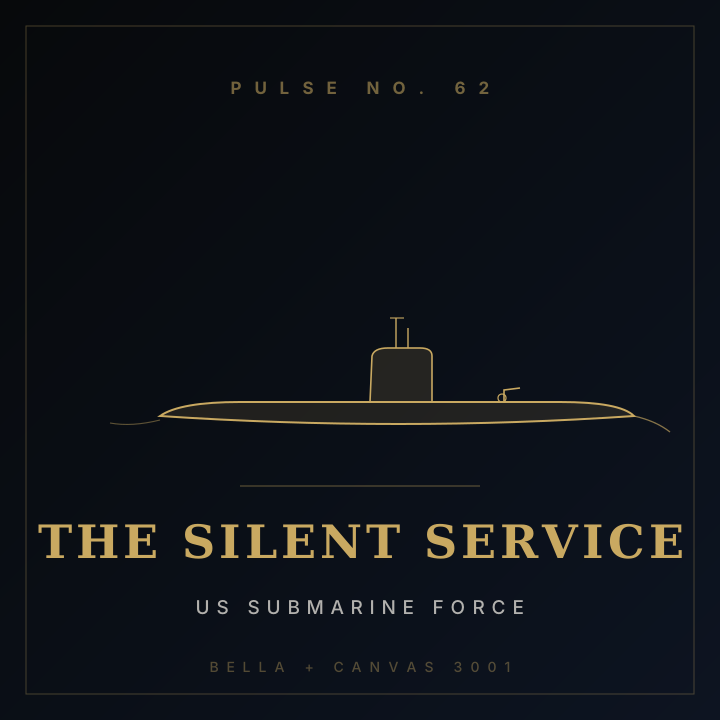
Silent Service Tee
THE SILENT SERVICE · US SUBMARINE FORCE
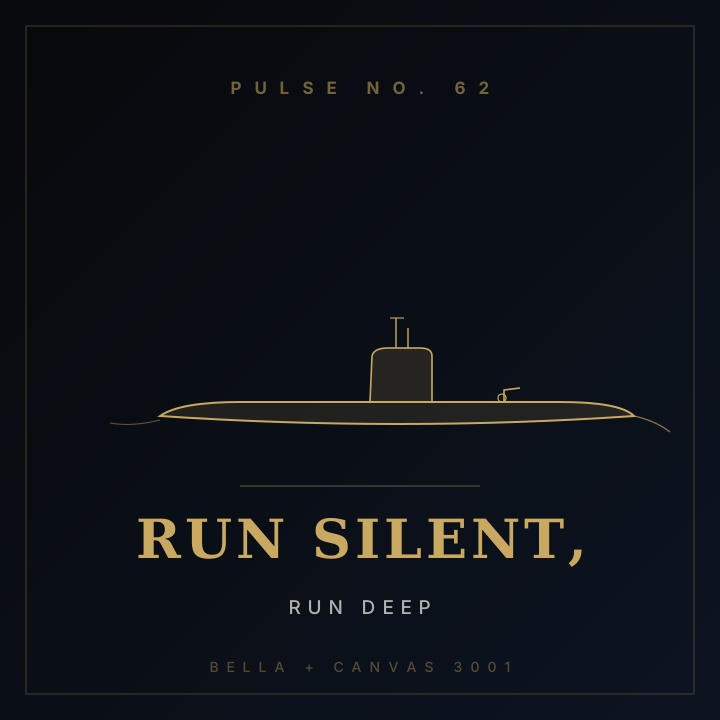
Run Silent, Run Deep
The submarine doctrine that won the Pacific logistics war.