Torrey Canyon — the wreck that created environmental maritime law.
March 1967: the supertanker Torrey Canyon grounded on the Scilly Isles and spilled 36 million gallons of crude oil. Britain bombed her with napalm to burn the oil. It didn't work. The law changed.
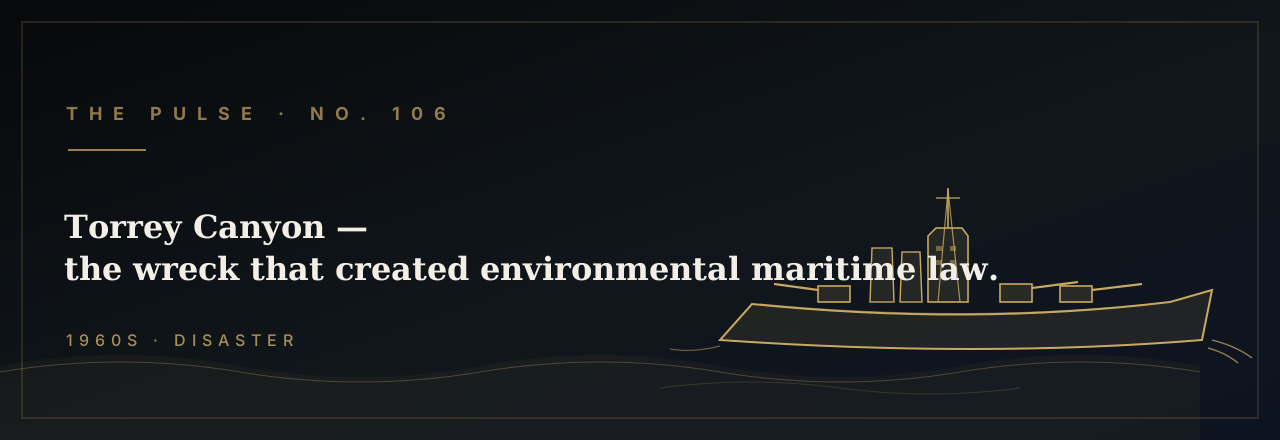
On the morning of March 18, 1967, the supertanker Torrey Canyon — 974 feet of American steel, riding deep with 119,328 tons of Kuwait crude — drove herself onto Pollard's Rock in the Seven Stones reef, seven miles southwest of Land's End. The seas were calm and the visibility was perfect. What destroyed Torrey Canyon was a tide window. Her captain, the Italian mariner Pastrengo Rugiati, had chosen to thread the narrow eastern passage between the Scilly Isles and the Cornish coast, buying hours he needed to make port at Milford Haven before the tide turned. He had made the crossing before. But on this particular Saturday morning, a failure on the bridge — a helmsman who disengaged the autopilot at exactly the wrong moment, confused orders, the rocks appearing ahead with no sea room remaining — left the ship with no margin and no time. She struck at sixteen knots, and the world's first great oil spill began.
The Torrey Canyon was herself a symbol of the postwar petroleum age. Very Large Crude Carriers had emerged in the 1950s and 1960s as the economics of oil transport demanded vessels of unprecedented scale. Torrey Canyon had been built in 1959 at Newport News Shipbuilding in Virginia at roughly 60,000 deadweight tons, then lengthened in Japan in 1964 to a staggering 120,000 DWT — cut in two amidships, a new midsection welded in, then sent back to sea. She was owned by the Barracuda Tanker Corporation, a subsidiary of Union Oil of California, and chartered to British Petroleum. On the morning she struck Pollard's Rock, she was the largest ship ever wrecked. Her cargo alone — 119,328 tons of crude, approximately 36 million US gallons — had no precedent in any spill the modern world had seen.
For days, the ship held on the reef while Dutch salvage crews attempted to refloat her, working against weather and an increasingly fractured hull. The slick spread northeast toward Cornwall and southeast toward Brittany, carried by tides and westerly winds. On March 26, with a northeast gale driving Torrey Canyon deeper onto the rocks and the hull breaking apart in three sections, Prime Minister Harold Wilson made a decision no head of government had ever made: he ordered the Royal Air Force to bomb a shipwreck. The logic was straightforward — ignite the crude, burn it off the water, contain the disaster before it reached the beaches. The reality was considerably more complicated.
What followed over March 26 through 28 was one of the more operationally bewildering episodes in postwar British military history. RAF Buccaneers from Lossiemouth and Royal Navy Sea Vixens flew more than forty sorties over the wreck, dropping thousand-pound bombs, canisters of aviation fuel, and napalm in an attempt to ignite the crude. Some bombs missed entirely. The fires that did catch were repeatedly extinguished by waves washing over the burning hull. The napalm, designed for overland interdiction, proved wildly unsuited to burning oil floating on open water. Television cameras on the Cornish headlands broadcast the campaign to a fascinated and increasingly appalled British public: here was the most powerful government in northwestern Europe deploying its military against a broken tanker — and apparently losing.
The detergent campaign that followed may have done more lasting damage than the oil itself. British authorities deployed approximately 10,000 tonnes of industrial dispersant — principally a product called BP1002 — across the slick and the fouled Cornish shoreline. The logic was as much cosmetic as ecological: the beaches had to be clear for the summer tourist trade. What the dispersants actually achieved was to break the crude into fine droplets that penetrated the water column far more deeply than surface oil ever would, poisoning marine invertebrates, destroying the intertidal zone, and killing an estimated 15,000 seabirds — more than any previous spill in recorded history. The French coast of Brittany, where local authorities largely refused the British dispersants and instead physically removed oil with bulldozers and buckets, recovered measurably faster. The lesson — that the cure can kill more than the disease — would take a generation to be properly absorbed.
What Torrey Canyon revealed most starkly was the complete absence of law adequate to the event. The 1954 International Convention for the Prevention of Pollution of the Sea by Oil had been written for the age of routine bilge-pumping, not supertanker catastrophe. No legal framework existed for a coastal state to act against a ship on the high seas, even one visibly destroying its coastline. No enforceable liability attached to the owner or charterer in any predictable way. The Inter-Governmental Maritime Consultative Organization (IMCO, the forerunner of today's IMO) convened emergency sessions and within two years produced instruments that remade the field: the 1969 Convention on Intervention on the High Seas granted coastal states the right to take measures — including destruction — against ships threatening their shores, even beyond territorial waters. The simultaneous Civil Liability Convention established strict liability and compulsory insurance for tanker owners. These two instruments formed the legal bedrock upon which MARPOL 73/78 — the comprehensive treaty governing marine pollution today — would be built.
The tremors reached California almost immediately. On January 28, 1969 — less than two years after Torrey Canyon's grounding — Union Oil of California, the same corporate parent that had owned Torrey Canyon through its Barracuda subsidiary, blew out Platform A in the Santa Barbara Channel, spilling more than 100,000 barrels of crude along eighty miles of Southern California coastline. The images — oiled beaches, dying brown pelicans, crude-blackened surf — became the founding photographs of the American environmental movement. Senator Gaylord Nelson flew to Santa Barbara for the cleanup and conceived Earth Day. Congress passed the National Environmental Policy Act. The Clean Water Act and Clean Air Act followed in rapid succession. San Diego's own coastline, its kelp beds, its harbor crowded with naval vessels, its fishing grounds running south to Baja — all of it now governed by law born in the wreck of a supertanker on a reef seven miles off Cornwall.
Maritime law, like all law, is written in the aftermath of catastrophe — and the catastrophes that shape it eventually shape us. Every tanker that transits San Diego Bay today, every naval replenishment ship that refuels at 32nd Street, moves under a legal regime built on the oil-stained beaches of Cornwall and Brittany, on the image of RAF jets dropping napalm on a broken hull, on the slow, furious realization that the sea itself could not absorb what we were pouring into it. Because without Torrey Canyon, there is no MARPOL, no intervention right, no civil liability framework — just ships, and oil, and a coastline with no recourse. The same Pacific. The same kelp-green swells. You could be on this water tonight, and the law protecting it was written in grief, in 1967, on a reef you'll never see from here.
Two designs for Pulse No. 106.
Bella + Canvas 3001 unisex tee. Printed on demand and shipped from the U.S. $34.99 + tax + shipping.
Torrey Canyon Tee
SS TORREY CANYON · MARCH 1967 · SEVEN SISTERS REEF
Napalm on the Sea
The Royal Navy's solution to an oil spill it couldn't contain.