Trieste — the bathyscaph that touched the bottom, deployed from San Diego.
January 23, 1960: Jacques Piccard and Don Walsh descended 35,787 feet to the Challenger Deep in the Mariana Trench. The Navy's bathyscaph Trieste, based in San Diego, made the only crewed descent to the deepest point on earth.
On the morning of January 23, 1960, the steel pressure sphere of the Navy bathyscaph Trieste touched the gray-brown silt of the Challenger Deep — 35,787 feet below the surface of the Pacific, nearly seven vertical miles beneath the sun. Inside the 56-inch sphere, Swiss oceanographer Jacques Piccard and U.S. Navy Lieutenant Don Walsh sat shoulder to shoulder, surrounded by instrument gauges, a sonar transceiver, and the realization that the pressure pressing against their hull — eight tons per square inch — was enough to collapse a conventional submarine like a tin can. No human being had ever reached so far beneath the sea, and none would again for fifty-two years. They stayed twenty minutes, then rose.
The vessel that made the descent possible was the invention of one of the twentieth century's most improbable polymaths. Auguste Piccard — Swiss physicist, balloonist, and Jacques's father — had already reached the stratosphere in a sealed gondola of his own design in 1931. When he turned his engineering genius toward the ocean floor, he applied the same logic in reverse: a vessel that could descend and ascend freely, without cables or tethers, under its own buoyancy. His solution was the bathyscaph — from the Greek for "deep boat" — a device whose enormous upper float was filled with aviation gasoline, which is lighter than seawater and, crucially, incompressible under even extreme pressure. Iron shot ballast, released by electromagnets to abort a dive, provided the weight to descend. The design was elegant in its simplicity: cut the current, drop the iron, rise.
The Trieste herself was built in 1953 at the shipyards of Castellammare di Stabia, near Naples, and her pressure sphere was forged by Krupp Steel of Essen, Germany — the same industrial dynasty that had armed two world wars. The sphere's walls were five inches thick, machined to tolerances of thousandths of an inch so that the hemisphere joints would compress and seal under pressure rather than fracture. The Piccards conducted early dives in the Mediterranean, but the vessel's ambitions outpaced European funding. In 1958, the U.S. Navy purchased the Trieste from the Piccard family for $250,000 — a bargain even then for an instrument capable of reaching the deepest point on Earth.
The Navy's interest was not purely scientific. In the anxious strategic climate of the Cold War, the ocean floor had become a new theater of contest. The Soviets had launched Sputnik the year before; the race for extreme environments was as much a demonstration of national capability as it was exploration. Project Nekton, the Navy's codename for the Challenger Deep mission, aimed to prove American reach extended not just into space but into the ocean's most inaccessible depths. The Office of Naval Research assigned Don Walsh, a twenty-eight-year-old submarine officer from the destroyer-and-diesel world of the surface Navy, to oversee the Trieste's operations. Walsh had never dived in a bathyscaph before he helped prepare this one for the deepest dive in history.
The Trieste was towed to the dive site in the Mariana Trench, approximately 200 miles southwest of Guam, by the destroyer escort USS Lewis. The descent began at 8:23 a.m. local time. For four hours and forty-seven minutes, Piccard and Walsh fell through water that grew progressively colder and darker, watching the depth gauge climb with no ability to abort quickly — it would take nearly an equal time to ascend. At around 30,000 feet, a loud crack rang through the sphere: a plexiglass window in the outer access tunnel had fractured under the pressure. They conferred briefly and continued. At 1:06 p.m., the Trieste's floodlights illuminated silt, and a small flatfish — later debated but widely reported as a flounder or sole — scattered away from the landing. Life, it turned out, existed even here, at the bottom of everything.
The Trieste's home port through this period was Naval Station San Diego, and the bathyscaph's presence on the waterfront made the base something more than a home for destroyers and amphibious ships. The Navy's deep-sea research program clustered around San Diego's Scripps Institution of Oceanography in La Jolla, one of the world's premier centers for ocean science, and the collaboration between Scripps researchers and Navy operators created a tradition of pushing the known limits of the sea from this harbor. In the years following the Challenger Deep dive, the Trieste remained on active service, most famously recovering the flight recorder from the lost nuclear submarine USS Thresher in 1963 — a reminder that extreme depth was not only a feat of exploration but an operational necessity.
The records Walsh and Piccard set that January morning proved almost impossibly durable. No crewed vessel returned to full ocean depth until 2019, when explorer Victor Vescovo descended in the submersible Limiting Factor and measured a slightly deeper point at 35,853 feet — equipment capable of precision that 1960 instruments could not achieve. The Trieste's dive had nonetheless established the outer boundary of the Earth's inhabitable surface with a certainty no subsequent mission has overturned. Don Walsh, who lived until 2023, spent the rest of his career as an ocean advocate, returning to the Mariana Trench in 2012 as a guest aboard James Cameron's solo dive in the Deepsea Challenger — a witness to the record he helped set being approached, but never quite broken.
What the Trieste proved, in twenty minutes of muddy silence seven miles below the surface, was that the ocean yields to patience and engineering and nerve — that the water covering 71 percent of this planet has no corner so remote it cannot be reached by someone willing to descend slowly and carefully enough. San Diego has always been a city that faces the Pacific and wonders what lies beyond the horizon, and some of those horizons run straight down. The same deep water. The same vast blue. You could look out over it tonight from the deck of JADA and know that everything beneath you, all the way to the bottom of the world, has a human footprint on it.
Two designs for Pulse No. 112.
Bella + Canvas 3001 unisex tee. Printed on demand and shipped from the U.S. $34.99 + tax + shipping.
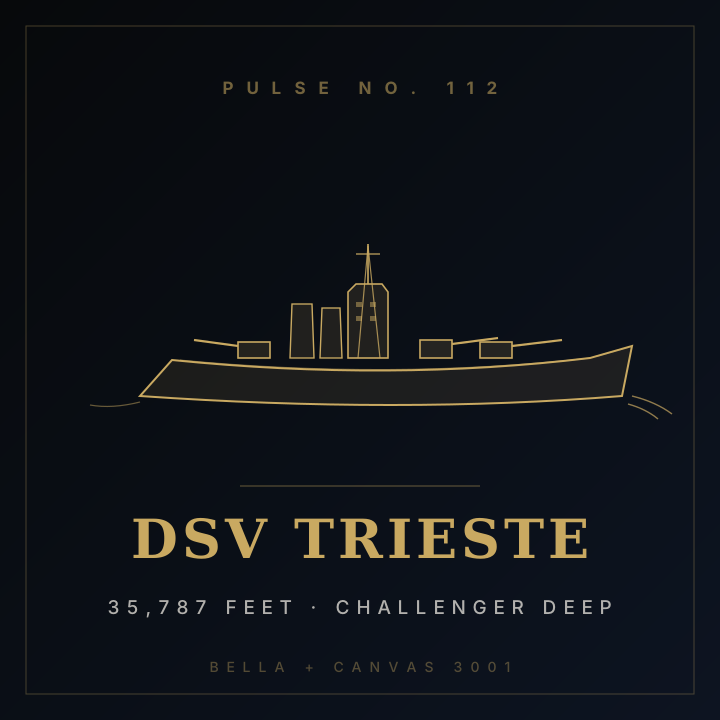
Trieste Tee
DSV TRIESTE · 35,787 FEET · CHALLENGER DEEP
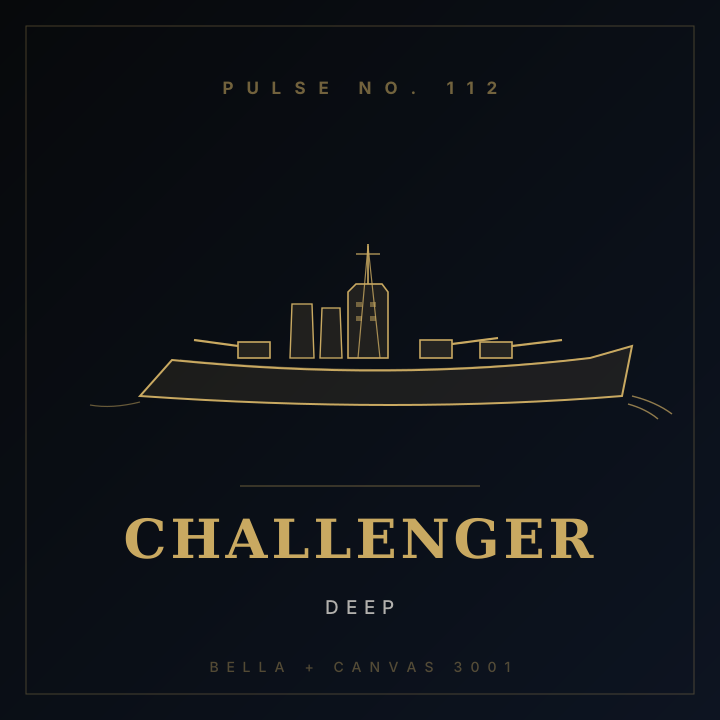
Challenger Deep
The deepest point on earth — named for a ship that measured it.