USS Constitution's last battle — the frigate that fought her final engagement in 1815 and is still commissioned today.
She fought thirty-three engagements in the War of 1812 and the quasi-war. Her last battle was with HMS Cyane and HMS Levant on February 20, 1815.
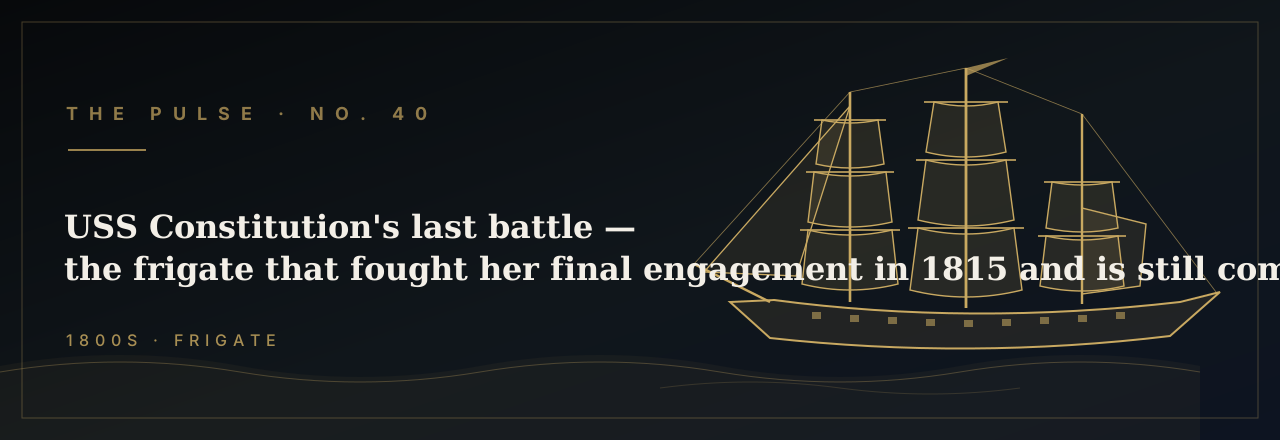
On the evening of 20 February 1815, some two hundred miles northeast of Madeira, a lookout aboard the American heavy frigate USS Constitution spotted twin sets of top-lights moving against the darkening Atlantic — HMS Cyane and HMS Levant, sailing in company, unaware they were bearing down on the most dangerous warship in the Western Hemisphere. The Treaty of Ghent had already been signed fifty-eight days earlier, on Christmas Eve 1814, formally ending the War of 1812 — but no word had yet crossed the Atlantic. Captain Charles Stewart, at the helm of the finest frigate the United States had ever sent to sea, cleared his ship for action.
She had been built for exactly this kind of fight. Joshua Humphreys, the Philadelphia shipwright commissioned to design a new American frigate in 1794, drew a vessel of radical ambition: she would outrun every ship-of-the-line in the Royal Navy and outfight every frigate afloat. Launched on 21 October 1797 at Edmund Hartt's shipyard in Boston, Constitution measured 204 feet at the keel, displaced 2,200 tons, and carried thirty 24-pound long guns on her main deck — a broadside weight of metal that rivaled warships a full rate above her in the British classification system. Her live-oak frames, harvested from the sea islands of Georgia and packed with such density that a carpenter's auger could scarcely penetrate them, would prove to be her most formidable weapon. Her copper sheathing, rolled at Paul Revere's mill in Canton, Massachusetts, kept her bottom clean and her speed constant in any sea.
Her fighting reputation was assembled across two decades of almost continuous conflict. During the Quasi-War with France (1798–1800), she patrolled the Caribbean under Commodore Silas Talbot, protecting American commerce at a moment when the young republic could not afford to lose a single merchant voyage. When war with Britain came in June 1812, Constitution had already logged tens of thousands of miles at sea — her hull proven, her captains blooded, her gun crews drilled. It was Captain Isaac Hull who brought her to her defining moment on 19 August 1812, when she ran down the British frigate HMS Guerrière four hundred miles south of Nova Scotia and reduced her to a sinking wreck in thirty minutes of close action. When British cannonballs were seen bouncing off her dense oak flanks, a sailor reportedly cried out that her sides must be made of iron — and the name "Old Ironsides" entered American memory for good.
The victories that followed built a record no American warship has matched before or since. Captain William Bainbridge destroyed HMS Java off Brazil in December 1812; Captain Charles Stewart bested the schooner HMS Pictou in April 1814. The Royal Navy, stung by the public humiliation of losing frigates it had considered invincible, issued a standing order against single-ship engagements with American heavy frigates. The Times of London condemned the defeats as "absolutely disgraceful"; Lloyd's Coffee House raised insurance rates the moment Constitution was reported at sea. She became the most hunted vessel in American waters — which was precisely why Stewart planned to take her far from them, out into the open Atlantic where her speed and firepower could operate without interference, carrying 451 men and orders to disrupt British commerce and draw enemy frigates off the American coast.
The man commanding her was worth the ship. Charles Stewart had gone to sea as a cabin boy at thirteen, earned his commission in the Quasi-War, and risen through the young American Navy to a reputation as one of its most precise tactical thinkers. He was in his mid-thirties when he assumed command of Constitution in 1813, and he spent the months before his final cruise drilling his gun crews in conditions that verged on the obsessive — reportedly requiring them to reload and fire in total darkness, by touch alone, so that gun smoke and night would offer his enemy no exploitable advantage. He believed, as Mahan would later argue in print, that gunnery was won in practice, not in battle, and that a frigate crew delivering three accurate broadsides to the enemy's two had already decided the outcome before the first shot was fired.
The engagement after sunset on 20 February was a clinic in exactly that philosophy. Cyane, a 22-gun sixth-rate under Captain Gordon Falcon, and Levant, a 20-gun brig-sloop under Captain George Douglas, together mounted roughly the firepower of a single light frigate — but they were two separate ships, and two ships working in concert can rake a single opponent bow and stern simultaneously, catching her in a crossfire she cannot answer with a broadside alone. Stewart refused to be caught between them. He maneuvered Constitution back and forth with a precision that left British officers incredulous in their subsequent reports, using his own gun smoke as a screen, dismasting Cyane first with concentrated fire that shredded her rigging, then pursuing Levant into the Atlantic darkness when she attempted to escape. Both ships had struck their colors before midnight. American losses: three killed, twelve wounded. British losses across both ships: forty-three. It was the most tactically complete single action of the entire war.
The coda contained an irony as large as the ocean itself. Stewart made for the Cape Verde Islands with both prizes in company, and on 11 April 1815 — by which time peace had been ratified and proclaimed in Washington — a British squadron of three frigates, HMS Newcastle, HMS Acasta, and HMS Leander, cornered them at Porto Praia. Stewart cut his prizes loose and ran. Constitution pulled away from all three pursuers without difficulty: Humphreys' design philosophy, tested one final time, held. Cyane escaped to windward and eventually reached New York with a prize crew aboard; Levant, slower and less fortunate, was retaken. The whole affair was legally incoherent — the war for which these ships had been seized was already concluded — and Levant's status would remain diplomatically contested for years. What mattered to the Navy was that Constitution herself came home with her record unbroken: thirty-three engagements, not a single defeat.
The frigate's reach extended further than the Atlantic. In 1844, Constitution sailed into the Pacific on a circumnavigation under the irrepressible Captain John "Mad Jack" Percival, touching at the Sandwich Islands and Manila before rounding homeward — a demonstration that American sea power now extended to every ocean on the globe. The spirit of that reach lives today along the piers of Naval Base San Diego, the largest surface warfare installation on the continent, where the destroyers and cruisers of the Third Fleet make their home. The Oliver Hazard Perry-class frigates — hull designation FFG, preserving the very word that Old Ironsides made synonymous with American fighting power — sailed from those same piers for a quarter century of Cold War patrols. And the warship that gave American naval identity its first great myth still rides at her berth in Charlestown Navy Yard in Boston Harbor: commissioned, crewed by active-duty sailors, and sailed under her own canvas on the anniversaries of her great victories, her pennant flying above water she first entered more than two centuries ago — the oldest warship still afloat anywhere in the world, and the only one never once defeated in battle.
Two designs for Pulse No. 40.
Bella + Canvas 3001 unisex tee. Printed on demand and shipped from the U.S. $34.99 + tax + shipping.
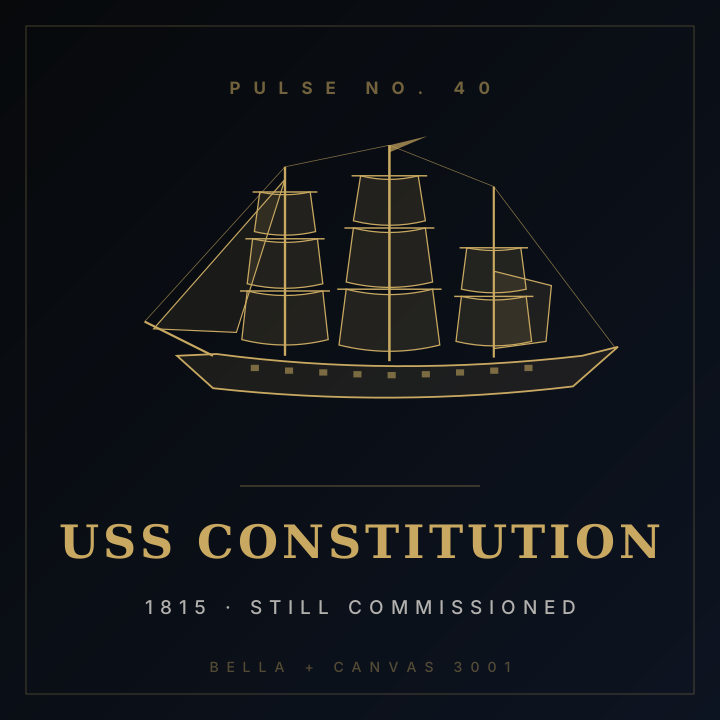
Constitution Last Battle Tee
USS CONSTITUTION · 1815 · STILL COMMISSIONED
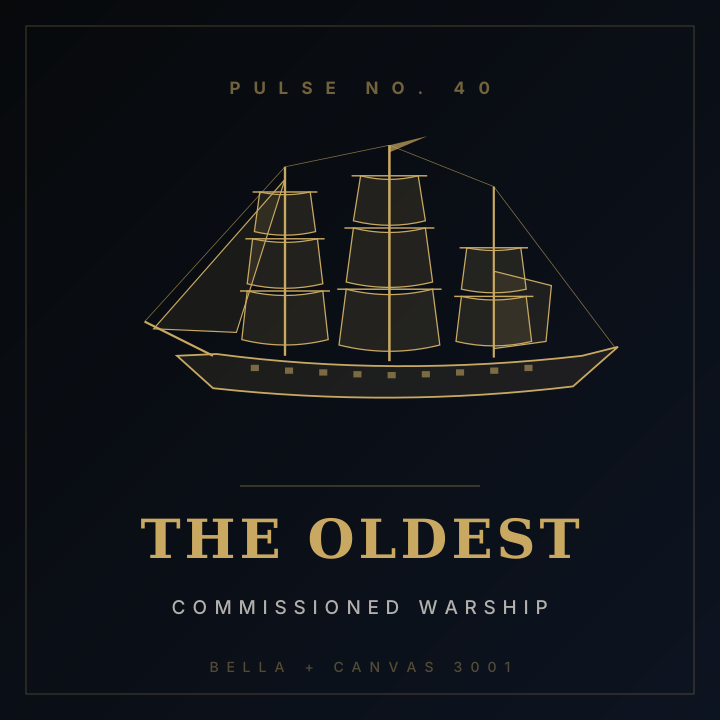
The Oldest Commissioned Warship
Constitution is the oldest commissioned warship afloat in the world.